Given this performance in global assets, one area within the global markets that stands out to us, and we think may be overlooked by global investors and traders, is Thailand.

Market Overview

As the second half of 2020 is in full swing, countries around the world have begun to slowly lift their COVID-19 lockdowns in an effort to get their economies up and running once again. It can’t be overlooked that the COVID-19 pandemic has had a detrimental impact on the health of the global economy, with global trade grinding to a halt, domestic and global GDP rates at levels not seen since the Great Depression, global unemployment levels in the double digits, and global financial markets falling from bull market to bear market territory in a matter of two short weeks.

Despite the doom and gloom seen in the global financial markets in February and March, the market is looking forward towards the second half of 2020 and charging ahead, as it appears that the global economy may have bottomed in April. To compliment this economic rebound, global financial markets seem to echo this bullish sentiment as well. Global markets signaled a bottom in March, as central banks in both Developed and Emerging Markets implemented accommodative monetary policies to ensure ample liquidity within the global financial system. Since March, a “Risk On” sentiment has taken hold within the global financial markets, as risky assets such as global equities, corporate bonds, and commodities have staged double digit rallies since their March lows.

Given this historic rebound in global assets, one area that we think may be overlooked by global investors and traders is Thailand.
Fundamentals

Due to the COVID-19 pandemic, Thailand’s economy shrank 1.8% in Q1 2020, for the first time in six years, as the tourist dependent country, which generates approximately 14% of its global economic activity from tourism, saw over 40 million potential tourists and visitors decide to stay at home.

However, in an effort to jump start the economy, the Thai government, with aid from the Bank of Thailand, approved a ฿1.9 trillion Baht (US$60 billion) stimulus package to bring the country out of recession and reinvigorate economic activity. Upon further inspection into this bailout package, the Thai government states that it is trying to target three important pillars of its economy: i) commercial banks and small and medium-sized business (SME), ii) households and workers, and iii) the financial services sector.

Market Sentiment

As a result of stimulative measures from the Thai government and the Bank of Thailand, as well as improving overall market sentiment, Thai assets have been some of the best performing assets within the East Asia Pacific region. Since bottoming in March, Thai equities have risen 33.90%, staging one of the most impressive rallies amongst the East Asia Pacific equity markets. To lend further support to this bullish thesis, the Thai Baht has also staged an impressive rally during the same time, rising 4.52% against the U.S. Dollar, to become one of the best performing currencies within the East Asia Pacific so far this year. Lastly, yields on the Thai 10-year government bond have fallen from 1.750% in March, to 1.185% in June, as global investors begin to venture back into Emerging Market bonds in search of investment opportunity.

Technical Analysis

Thai Equities Bullish

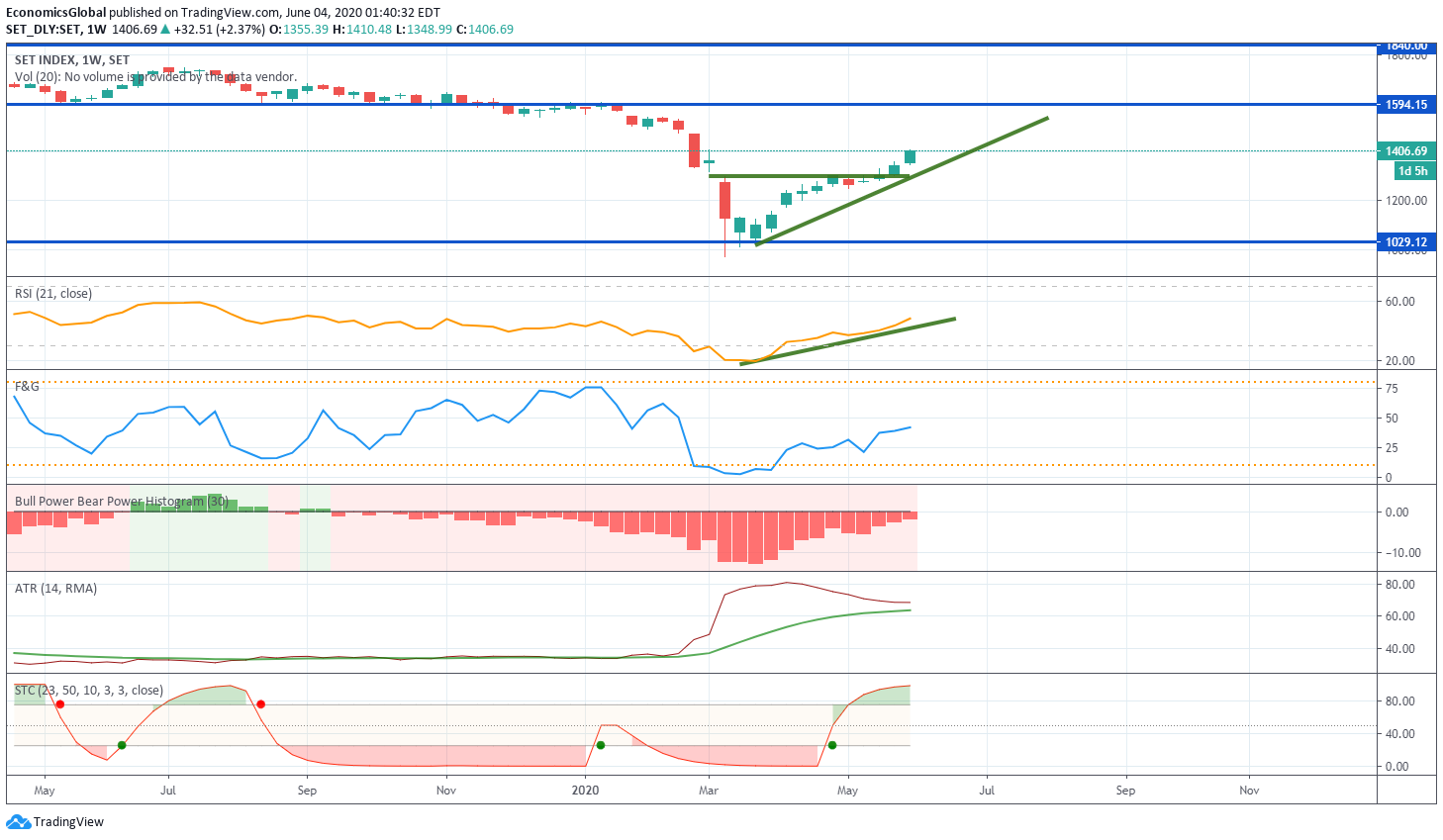
After consolidating for four weeks, and finally breaking through a textbook Ascending Triangle pattern, Thai equities have taken off with its global peers.

From a technical perspective, Thai equities are currently in an uptrend, backed by improving domestic and global factors. Since March, the recent momentum in Thai equities continues to be supported by a rising trend line (Green Trend Line), indicating that the bulls are fully in control. Furthermore, Thai equities continue to boast a rising RSI, indicating that the recent increase in prices is backed by solid bullish momentum.

Additionally, market sentiment continues to be in the bulls’ favor as well, as shown by key market sentiment indicators. According to the Bull Power Bear Power Histogram, this indicator shows that bullish sentiment is creeping back into Thai equities, after bearish sentiment bottomed in late March/early April, as investors feel more comfortable with taking on more risk. Furthermore, the Schaff Trend Cycle finally emerged from its weekly slump in late April and entered into green territory, indicating that Thai equities are firmly in a weekly bull cycle.

As an additional caveat, when looking at the fundamentals of East Asia Pacific equity markets, the PE ratio on the Thai SET index has seen a rebound from its February decline, as Thai equities continue to make a comeback within the region. So much so, that the PE ratio for the Thai SET index jumped from 13.04 in March to 15.13 in April, the second highest in the region, and only behind the FTSE Bursa Malaysia KLCI Index at 19.04, as investors made their way into Thai equities in the hopes of a steady recovery.


Overall, we do like Thai equities at the moment, and believe that if this momentum continues, we believe the next stop for the SET is 1594 (Blue Weekly Trend Line).
10-Year Thai Government Bonds: Prices: Bearish; Yields: Bullish

10-Year Thai government bond prices put in a multi-week bottom at ฿100.60, after selling off from ฿105.91 in early March. Since their March bottom, bond prices rallied to ฿105.18 in late May as investor confidence crept back into Emerging Market bonds. However, since early June, 10-Year Thai government bonds have sold off once again, dropping to ฿102.30 and heading lower. Moreover, bond prices have been range bound between ฿100.60-฿105.91, since the start of this year.

When it comes to market technicals for 10-Year Thai government bond prices, the picture is a little bit more mixed. The RSI on the 10-Year Thai bonds, despite being supported by a rising trend line, seems to have hit a “Double Top” at 50, and heading lower with prices. To us, this indicates that market bulls are trying to push momentum higher, but their push isn’t as strong as in other Thai assets.

Further, market sentiment seems to be quite mixed here as well. On one hand, the Bull Power Bear Power Histogram is still in bear territory, and does not seem to be making a push higher, but on the other, the Schaff Trend Cycle turned positive in late April, indicating bullish momentum is underway.

One area that could provide us with an idea as to where 10-Year Thai bond prices are headed, are trends in 10-Year Thai government bond yields.

Yields in 10-Year Thai bonds have fallen from 1.539% in March to around 1.00% in mid-May. However since bottoming in May, 10-Year Thai bond yields have been trending higher, to 1.34% where they currently sit as of this post. To lend more support for rising 10-Year Thai bond yields, yields broke above the declining weekly trend line (Red Weekly Trend Line), and closed higher, indicating that the recent weekly decline in yields has ended, and that yields have begun to reverse higher. This rise in yields is backed by steady bullish momentum in the RSI, which to us, indicates that yields have more room to run, and could spell trouble ahead for bond prices.

Moreover, market experts note that 10-Year Thai bond yields may continue to rise in the second half of the year, as the market expects increased government bond issuance from the Bank of Thailand, to fund economic stimulus measures throughout the country. As a
result, many expect that this additional increase in bond supply will send bond prices lower, and send yields higher later on in the year.

Going forward, we have a neutral view on 10-Year Thai government bonds. We currently have a more bearish outlook on 10-Year Thai government bond prices, in that we do see both technical and fundamentals reasons for bond prices to remain range bound, or even move lower in the interim. Conversely, we are bullish on 10-Year Thai government bond yields, as we do see opportunities in Thai bonds for investors who want to focus solely on trade ideas stemming from the rise in bond yields.
 
Thus we would recommend to investors and traders to be cautious in this space.
Thai Baht (USD/THB) – Bullish

After peaking at ฿33.18 in April, the Thai Baht (USD/THB) has seen a massive rally against the US Dollar, as risk sentiment has appeared in the global markets, and as 10-Year Thai bond yields have risen off their weekly lows in recent sessions.

From a technical perspective, the Thai Baht is currently in an a downtrend, backed by improving domestic and global fundamentals. Since early April, the surge in bullish momentum for the Thai Baht continues to be in full force, as the currency pair has been in a steady decline since peaking in late March. Further, the RSI for the Thai Baht continues be in a steady decline as well, indicating that global traders have dumped the US Dollar for the Thai Baht, as they feel more comfortable taking on more risk within the FX space.

Market sentiment continues to be bullish for the Thai Baht as well. According to the Bull Power Bear Power Histogram, though the indicator continues to show bullish momentum for the US Dollar, it has come off its April highs, and continues to trend downward, indicating that bullish momentum is swinging towards the Baht. Additionally, the Schaff Trend Cycle turned negative in mid-May, and has been in red territory since. This indicates to us that as a weekly bull cycle has started for the Baht, a simultaneous bearish cycle has started for the US Dollar.

However, we must express some caution for traders and investors in the Thai Baht, based on some recent commentary from the country’s central bank. Bank of Thailand officials cautioned that the recent appreciation in the currency may lead to speculative capital flows into the country, which could imperil the Thai economy. As a result, they cautioned that they would take the necessary steps to curb a rapid appreciation in the Baht in an effort to support the country’s economy, and ensure a steady economic recovery.
 
Nonetheless, we still do like the Thai Baht based on improving economic fundamentals and the “Risk On” sentiment underlying the global markets at the moment. If this bullish momentum continues, and the Bank of Thailand remains on the sidelines despite their remarks, we do believe the next stop for the Thai Baht is ฿30.17, a level not seen since early January.
© 2020 Economics Global Inc.

Content Disclaimer
Any views expressed here are those of Economics Global Inc. as of the date of this publication, are based on available information, and are subject to change without notice. This document does not constitute investment advice.
The value of investments and the income they generate may go down as well as up and it is possible that investors will not recover their initial outlay. Past performance is no guarantee for future returns.
Privacy Settings
We use cookies to enhance your experience while using our website. If you are using our Services via a browser you can restrict, block or remove cookies through your web browser settings. We also use content and scripts from third parties that may use tracking technologies. You can selectively provide your consent below to allow such third party embeds. For complete information about the cookies we use, data we collect and how we process them, please check our Privacy Policy
Youtube
Consent to display content from - Youtube
Vimeo
Consent to display content from - Vimeo
Google Maps
Consent to display content from - Google
Spotify
Consent to display content from - Spotify
Sound Cloud
Consent to display content from - Sound